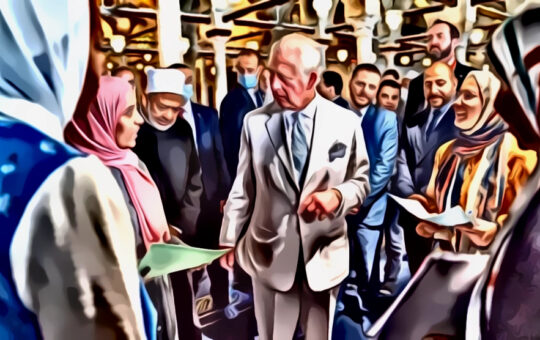
Gisteren verscheen er op X een doorwrochte boodschap van een Engelse bisschop gericht aan zijn religieuze baas, King Charles III, hoofd van “Church of England”.
We willen u de boodschap niet onthouden, omdat het een zeldzame noodkreet is waarvan de inhoud relevant is voor iedereen in het avondland. De bisschop is een diplomaat want hij benoemt de olifant in de kamer net niet.
De Nederlandse vertaling staat exclusief voor onze abonnees onderaan de tekst. Indien U geen Nederlandse vertaling ziet staan bent u geen abonnee of bent u niet ingelogd.
**
Bishop Ceirion H. Dewar FSHC – @BishopDewar
As a Bishop, I cannot stay silent. I have today drafted and sent an open letter to His Majesty King Charles III, the text of which reads as follows:
To:
His Majesty, Charles III,
King of the United Kingdom and the Realms,
Supreme Governor of the Church of England,
Bearer of the ancient title Defender of the Faith.
Your Majesty,
I write to you neither as a politician nor as a commentator, but as one of your loyal subjects who, as a bishop of Christ’s Church, cannot remain silent while the Christian foundations of this kingdom are steadily dismantled.
Sir, there are moments in the life of a nation when silence becomes a form of betrayal. If I refused to speak to Your Majesty now, this would be such a moment.
For more than a thousand years the Crown of this realm has stood in solemn covenant with the Christian faith.
The laws of this land were shaped by it.
The liberties of our people were nurtured by it.
The conscience of our civilisation was formed by it.
From the abbeys of medieval England to the parish churches of our villages, from the preaching of the Reformers to the missionary zeal that carried the Gospel to the ends of the earth, the Christian faith has not merely influenced Britain — it has defined her.
Yet today that inheritance is being quietly but deliberately eroded. Across the institutions of this nation there is a growing hostility toward the faith that built them.
Christian belief is mocked in the public square. Christian morality is dismissed as intolerance. Christian institutions are pressured to surrender doctrine in order to conform to the ideology of the age.
Within the very Church that bears the name of England, voices have arisen that appear more eager to mirror the spirit of the age than to proclaim the eternal truth of the Gospel.
Meanwhile, beyond the walls of our churches, powerful political movements openly speak of removing Christianity from its historic place within the life of this nation.
What would once have been whispered is now proclaimed openly: that Britain must become a post-Christian state.
It is in this context that I write to you, Your Majesty. For the British Crown does not stand apart from this crisis.
The Sovereign of this realm bears a title that is not merely historic but sacred in its origin and meaning: Defender of the Faith. Those words are not decorative. They are a charge.
They speak of a monarch whose duty is not merely to preside over the ceremonies of the Church, but to stand as a guardian of the Christian inheritance of the nation.
Yet many among your subjects now ask, with increasing anxiety: “Who will defend that inheritance today?”
They see a nation drifting from its foundations. And they ask whether the Crown will remain silent while that inheritance is dismantled.
Your Majesty, may I be so bold as to observe that your coronation oath was not a poetic formality. It was a solemn vow made before Almighty God to maintain and preserve the Protestant Reformed Religion established by law.
Those words bind the conscience of the sovereign. They remind the Crown that its authority is not merely constitutional but moral. The monarch is not merely a symbol of national continuity, but a custodian of the spiritual inheritance that shaped this realm.
History records moments when kings and emperors were confronted by the Church and reminded that their authority was accountable before God. In the fourth century Ambrose of Milan stood before the Emperor Theodosius I and reminded him that even the ruler of an empire must bow before the moral law of Christ.
That tradition of prophetic witness has never disappeared. Nor should it. For when rulers forget the foundations upon which their authority rests, the Church must speak — not with hostility, but with holy clarity.
And so, I write to say this, Your Majesty: The Christian character of this nation is under profound and accelerating assault.
If the Crown does not stand visibly and courageously in defence of that inheritance, history will record that the guardians of Britain’s institutions watched in silence as the foundations were removed.
The issue before us is not nostalgia. It is civilisation. Remove Christianity from the story of Britain and you do not create a neutral society — you create a moral vacuum. And history teaches us that moral vacuums are never left empty for long.
Your Majesty now stands at a crossroads that few monarchs in modern history have faced.
For the erosion of Britain’s Christian inheritance will not ultimately be judged by speeches made in Parliament or debates in the press. It will be judged by whether those entrusted with the guardianship of our ancient institutions chose to defend them — or merely preside over their quiet surrender.
You may preside over the quiet dissolution of Britain’s Christian identity. Or you may rise to the ancient responsibility entrusted to the Crown and speak with clarity about the faith that built this kingdom. The first path requires little courage. The second will require a great deal. But it is the path that history honours.
Your Majesty’s subjects are not asking for religious coercion. They are asking for leadership. They are asking that the sovereign who bears the title Defender of the Faith remember what that title means.
They are asking that the Crown hear the growing cry of anguish from Christians across this land who feel that the spiritual inheritance of their nation is being surrendered without resistance. And they are asking whether the Crown will stand with them.
For the faith that shaped Britain is not merely a cultural ornament. It is the wellspring from which our laws, our liberties, and our moral imagination have flowed. If it is cast aside, the nation will discover — too late — that it has severed itself from the very roots that sustained it.
Your Majesty, to many the Crown is a symbol of authority. But before God it is also a symbol of stewardship. And stewardship carries with it the duty to defend what has been entrusted.
May Almighty God grant Your Majesty the wisdom to discern this hour, and the courage to fulfil the sacred duty entrusted to the Crown.
Yours faithfully,
Bishop Ceirion H. Dewar FSHC
Missionary Bishop
Diocese of Providence
Confessing Anglican Church
De brief was evenzo gericht aan:
@PhilHs10
@RevBrettMurphy
@revwickland
@BishopRobert1
@GBNews
@TalkTV
@danwootton
@Jacob_Rees_Mogg
@LozzaFox
@BackBrexitBen
@RupertLowe10
@KemiBadenoch
@JohnCleese
**
Tekst in het Nederlands
Bisschop Ceirion H. Dewar FSHC – @BishopDewar
Als bisschop kan ik niet zwijgen. Vandaag heb ik een open brief opgesteld en verstuurd aan Zijne Majesteit Koning Charles III. De tekst luidt als volgt:
Aan:
Zijne Majesteit, Charles III,
Koning van het Verenigd Koninkrijk en de Rijksdelen,
Opperste Gouverneur van de Kerk van Engeland,
Drager van de oude titel Verdediger van het Geloof.
Uwe Majesteit,
Ik schrijf u niet als politicus noch als commentator, maar als een van uw trouwe onderdanen die, als bisschop van Christus’ Kerk, niet kan zwijgen terwijl de christelijke fundamenten van dit koninkrijk geleidelijk worden afgebroken.
Heer, er zijn momenten in het leven van een natie waarop zwijgen neerkomt op verraad. Als ik nu zou weigeren tot Uwe Majesteit te spreken, zou dit zo’n moment zijn.
Al meer dan duizend jaar staat de Kroon van dit rijk in een plechtig verbond met het christelijk geloof.
De wetten van dit land zijn erdoor gevormd.
De vrijheden van ons volk zijn erdoor gevoed.
Het geweten van onze beschaving is erdoor gevormd.
Van de abdijen van middeleeuws Engeland tot de parochiekerken in onze dorpen, van de prediking van de hervormers tot de missionaire ijver die het evangelie tot aan de uiteinden van de aarde bracht: het christelijk geloof heeft Groot-Brittannië niet slechts beïnvloed — het heeft haar gedefinieerd.
Toch wordt dit erfgoed vandaag stil maar doelbewust uitgehold. In de instellingen van deze natie groeit de vijandigheid tegenover het geloof dat hen heeft voortgebracht.
Christelijk geloof wordt bespot in het publieke debat. Christelijke moraal wordt afgedaan als intolerant. Christelijke instellingen worden onder druk gezet om hun leer op te geven en zich aan te passen aan de ideologie van de tijd.
Binnen de Kerk zelf, die de naam van Engeland draagt, zijn stemmen opgestaan die meer geneigd lijken de geest van de tijd te weerspiegelen dan de eeuwige waarheid van het evangelie te verkondigen.
Tegelijkertijd spreken machtige politieke bewegingen, buiten de muren van onze kerken, openlijk over het verwijderen van het christendom uit zijn historische plaats in het leven van deze natie.
Wat vroeger gefluisterd werd, wordt nu openlijk verkondigd: dat Groot-Brittannië een post-christelijke staat moet worden.
Het is in deze context dat ik u schrijf, Uwe Majesteit. Want de Britse Kroon staat niet los van deze crisis.
De vorst van dit rijk draagt een titel die niet slechts historisch is, maar heilig in oorsprong en betekenis: Verdediger van het Geloof. Deze woorden zijn geen versiering. Zij vormen een opdracht.
Zij duiden op een monarch wiens taak niet enkel is om kerkelijke plechtigheden voor te zitten, maar om op te treden als beschermer van het christelijk erfgoed van de natie.
Toch vragen velen onder uw onderdanen zich vandaag, met groeiende bezorgdheid, af: “Wie zal dat erfgoed vandaag verdedigen?”
Zij zien een natie die afdrijft van haar fundamenten. En zij vragen zich af of de Kroon zal zwijgen terwijl dat erfgoed wordt afgebroken.
Uwe Majesteit, sta mij toe zo vrij te zijn op te merken dat uw kroningseed geen poëtische formaliteit was. Het was een plechtige belofte, afgelegd voor de Almachtige God, om de protestants-hervormde religie, zoals wettelijk vastgesteld, te handhaven en te bewaren.
Deze woorden binden het geweten van de vorst. Zij herinneren de Kroon eraan dat haar gezag niet alleen constitutioneel is, maar ook moreel. De monarch is niet slechts een symbool van nationale continuïteit, maar ook een bewaker van het geestelijk erfgoed dat dit rijk heeft gevormd.
De geschiedenis kent momenten waarop koningen en keizers door de Kerk werden aangesproken en eraan werden herinnerd dat hun gezag verantwoording verschuldigd is aan God. In de vierde eeuw trad Ambrosius van Milaan de keizer Theodosius I tegemoet en herinnerde hem eraan dat zelfs de heerser van een rijk zich moet onderwerpen aan de morele wet van Christus.
Die traditie van profetisch getuigenis is nooit verdwenen — en mag dat ook niet. Want wanneer heersers de fundamenten van hun gezag vergeten, moet de Kerk spreken — niet met vijandigheid, maar met heilige helderheid.
Daarom schrijf ik u dit, Uwe Majesteit: het christelijke karakter van deze natie staat onder een diepgaande en toenemende aanval.
Als de Kroon niet zichtbaar en moedig opkomt voor dat erfgoed, zal de geschiedenis vastleggen dat de hoeders van de Britse instellingen zwijgend toekeken terwijl de fundamenten werden weggenomen.
Waar het nu om gaat, is geen nostalgie. Het gaat om beschaving. Verwijder het christendom uit het verhaal van Groot-Brittannië, en u creëert geen neutrale samenleving — u creëert een moreel vacuüm. En de geschiedenis leert dat zulke vacuüms nooit lang leeg blijven.
Uwe Majesteit staat nu op een kruispunt dat maar weinig moderne monarchen hebben gekend.
De afbraak van het christelijk erfgoed van Groot-Brittannië zal uiteindelijk niet worden beoordeeld op basis van toespraken in het parlement of debatten in de pers. Zij zal worden beoordeeld op de vraag of degenen die belast waren met het hoeden van onze oude instellingen ervoor kozen deze te verdedigen — of slechts toe te zien hoe zij stilletjes werden prijsgegeven.
U kunt toezien op de stille ontbinding van de christelijke identiteit van Groot-Brittannië. Of u kunt opstaan en de oude verantwoordelijkheid van de Kroon opnemen, en met duidelijkheid spreken over het geloof dat dit koninkrijk heeft opgebouwd. Het eerste pad vergt weinig moed. Het tweede des te meer. Maar het is het pad dat door de geschiedenis wordt geëerd.
Uw onderdanen vragen niet om religieuze dwang. Zij vragen om leiderschap. Zij vragen dat de vorst die de titel Verdediger van het Geloof draagt, zich herinnert wat die titel betekent.
Zij vragen dat de Kroon de groeiende roep van bezorgdheid hoort van christenen in dit land, die het gevoel hebben dat het geestelijk erfgoed van hun natie zonder verzet wordt opgegeven. En zij vragen zich af of de Kroon naast hen zal staan.
Want het geloof dat Groot-Brittannië heeft gevormd, is niet slechts een cultureel ornament. Het is de bron waaruit onze wetten, onze vrijheden en ons moreel besef zijn voortgekomen. Als het wordt verworpen, zal de natie — te laat — ontdekken dat zij zich heeft losgesneden van de wortels die haar hebben gedragen.
Uwe Majesteit, voor velen is de Kroon een symbool van gezag. Maar voor God is zij ook een symbool van rentmeesterschap. En rentmeesterschap brengt de plicht met zich mee om te beschermen wat is toevertrouwd.
Moge de Almachtige God Uwe Majesteit de wijsheid schenken om dit moment te doorzien, en de moed om de heilige taak van de Kroon te vervullen.
Hoogachtend,
Bisschop Ceirion H. Dewar FSHC
Missionair bisschop
Bisdom Providence
Belijdende Anglicaanse Kerk